

Plant leaders don't have much patience for vendor promises that don't hold up in a production environment. It went through its share of inflated expectations — smart factory presentations that looked impressive in a conference room and underdelivered in a real facility with legacy equipment, inconsistent data, and three shifts running at different standards.
That era is largely over. The manufacturers now deploying AI are doing it for a simple operational reason: when applied to the right problems and built on connected data, it genuinely helps them hit production targets, reduce unplanned downtime, and manage quality variability more effectively.
McKinsey's research puts concrete numbers behind that claim — manufacturers are seeing double-digit cost savings within twelve months of deploying industrial AI. Deloitte's 2026 Industry Outlook identifies scheduling, planning, and workforce management as the primary areas of AI investment for manufacturers this year. The value of AI for Manufacturing is real, but it's concentrated in specific operational problems where the data infrastructure exists to support it.
This blog covers the six use cases creating the most operational impact on the plant floor — and what it takes to build the connected data foundation that makes any of them actually work in production.
Key Takeaways
- AI in manufacturing has moved firmly past the hype stage — plant leaders are evaluating it by one standard: does it improve how we hit production targets, reduce downtime, and control quality?
- Real-time AI monitoring works best when production, maintenance, and quality data sit in one connected operational layer — fragmented data is the most consistent reason AI projects stall on the shop floor.
- Predictive maintenance, AI-powered scheduling, real-time defect detection, and intelligent bottleneck analysis are the four use cases delivering the fastest, most measurable returns in 2026.
- McKinsey reports manufacturers are seeing double-digit cost savings within 12 months of deploying industrial AI — the payoff is real, but it depends on data readiness and the right platform architecture.
- AlphaNext's Alpha iFactory platform connects planning, production, sales, maintenance, and quality intelligence into one operational ecosystem, turning fragmented shop floor data into decisions that actually get made.
What AI Actually Does in a Production Environment
In operational terms, AI in manufacturing analyzes plant data and surfaces patterns, risks, or predictions that help teams make better decisions than they could from static reports or periodic inspections.
The data it operates on spans the full production environment: machine sensor signals, maintenance logs, downtime events, quality inspection results, production counts, shift records, material batch tracking, and energy consumption. evaluate this information continuously and at a scale that no manual review process could match — detecting trends that aren't obvious in daily reports and flagging emerging issues earlier than traditional dashboards.
The goal isn't to replace the judgment of plant managers or maintenance engineers. It's to get them better information, faster, so the decisions they make are based on what's actually happening across the operation rather than what was true when the last report was compiled.
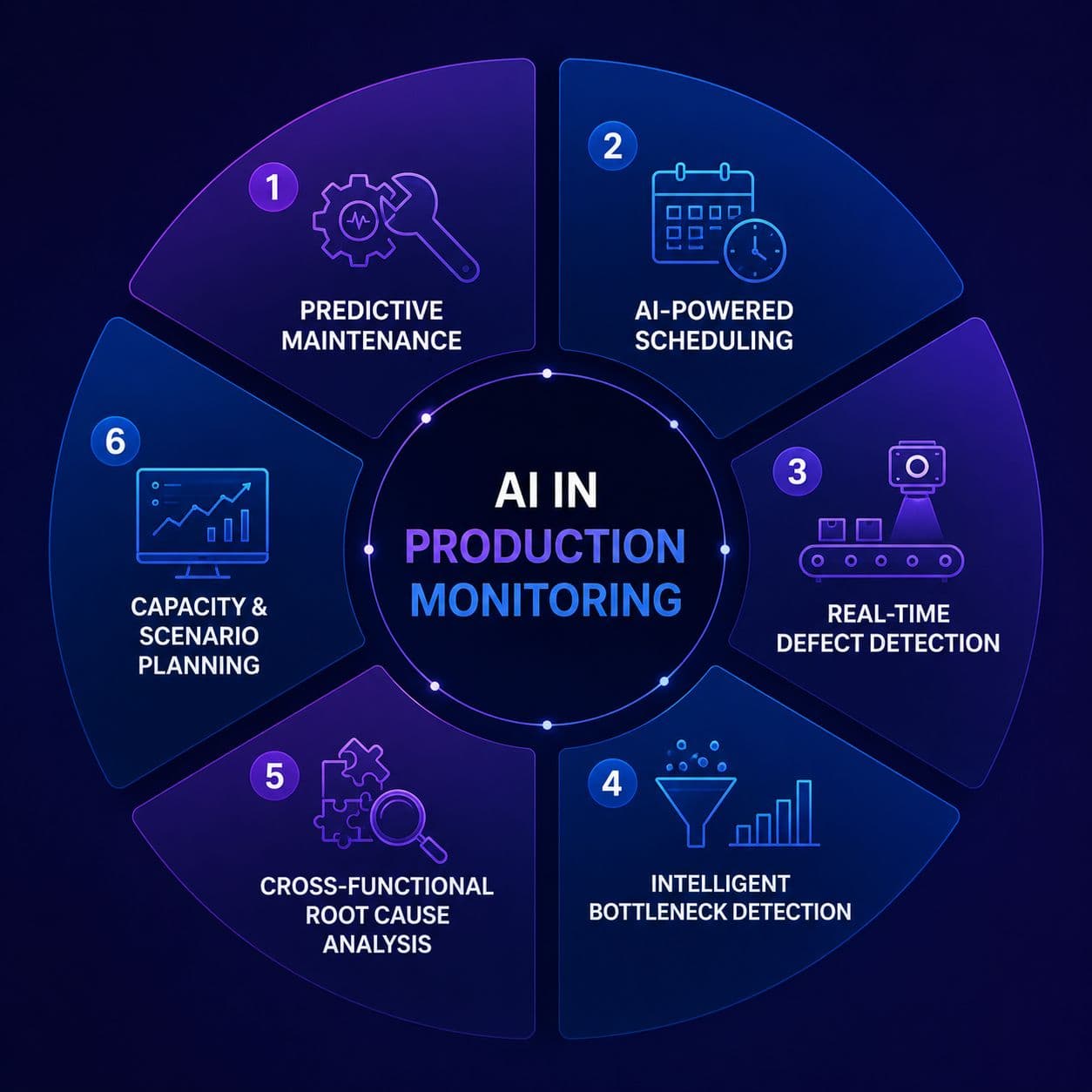
Six Use Cases Where Real-Time AI Monitoring Delivers Results
1. Predictive Maintenance: From Reactive to Proactive
Unplanned downtime is consistently one of the biggest constraints on production output — and one of the most expensive, because it compounds quickly. A machine that goes down unexpectedly doesn't just stop producing; it creates scheduling chaos, forces reactive maintenance decisions, and causes downstream lines to starve.
Predictive maintenance changes the model fundamentally. AI models analyze historical machine data, sensor signals, and failure patterns continuously, calculating breakdown risk in real time rather than waiting for a scheduled inspection or a machine to actually fail.
The operational benefits are clear:
- Better machine performance — knowing a component is trending toward failure allows maintenance to be scheduled during controlled windows rather than emergency shutdowns
- Extended asset lifespan — predicting failures before they cause physical damage reduces the wear that shortens equipment life
- Lower maintenance cost — preventing unnecessary part replacement and optimizing spare parts inventory both reduce operating expenditure
For production managers, predictive maintenance — powered by AI Automation of continuous sensor analysis — means fewer unexpected schedule disruptions and more reliable throughput. It's one of the most mature and most widely adopted applications of AI for Manufacturing precisely because the ROI is so direct and measurable.
2. AI-Enhanced Production Scheduling
Scheduling in complex manufacturing environments is genuinely hard. It has to balance labor availability, machine capacity, material arrival times, and changeovers — in real time, across multiple constraints that are all changing simultaneously.
Traditional scheduling relies on static data and planner experience. Both are limited in how quickly they can respond to variability. A line trending slow, a machine running behind cycle time, a material delivery arriving late — these signals exist in the data long before they show up in a missed target.
can evaluate operational data continuously and spot schedule risk before it cascades. A line trending slow gets flagged early. Workers can be reassigned. Sequencing changes can be tested before delays compound across the floor.
Research published in Scientific Reports on smart production management specifically identifies AI-driven scheduling and real-time optimization as key priorities among manufacturers adopting intelligent systems — and their adoption rates are climbing faster than other AI applications.
3. Real-Time Defect Detection
Quality control has traditionally been labor-intensive, periodic, and error-prone. Human inspectors working long shifts with consistent visual attention to small defects is an inherently unreliable system — not because inspectors aren't skilled, but because human attention is inherently variable.
AI-powered computer vision systems change the reliability equation. They scan products continuously as they move through the line, detecting surface defects, assembly errors, dimensional inaccuracies, and anomalies that human inspection would catch inconsistently.
Instead of relying on sample-based inspection, real-time AI assesses every unit produced. Early detection means issues get caught before they move downstream, reducing scrap rates, preventing rework costs, and improving first-pass yield. Quality teams can redirect effort toward the systemic process improvements that prevent defects rather than the repetitive visual checks that catch them after the fact.
This is where real-time quality monitoring produces one of the most consistently compelling business cases in manufacturing AI — the math on scrap reduction and rework prevention is usually both straightforward to calculate and straightforward to verify.
4. Intelligent Bottleneck Detection
Production bottlenecks are rarely as obvious as they sound. The most damaging ones accumulate quietly — recurring slowdowns on a specific machine that individually seem minor, unusually long queue times during certain shifts, cumulative effects of small stops that add up to significant throughput loss across a week.
Static reports and daily summaries don't surface these patterns clearly because they aggregate away the variability. can analyze production data at a granular level and reveal what the summary numbers hide — that a sequence of small delays on one machine is creating a constraint limiting output downstream, or that a particular shift consistently loses time at a specific step that never shows up as a single large incident.
For production leaders, this kind of insight allows interventions to be prioritized where they actually unlock capacity. That's a meaningful difference in how improvement resources get allocated.
5. Cross-Functional Root Cause Analysis
Production problems rarely stay in one silo. A spike in scrap may connect to a maintenance interval that slipped. Recurring downtime might align with a specific material batch. A quality issue that looks like an operator error might trace back to a calibration drift maintenance hasn't flagged.
Research on smart production management shows that AI supports cross-functional insight — connecting quality, maintenance, and production data in ways that manual analysis would require significant time and effort to replicate. The patterns exist in the data; the question is whether the operational platform surfaces them before teams spend days chasing the wrong root cause.
Teams that can link outcomes across quality, maintenance, and production datasets address root causes directly rather than repeatedly treating symptoms — and that efficiency compounds across every continuous improvement cycle.
6. Capacity Planning and Scenario Evaluation
AI's ability to and current conditions makes it genuinely useful for production capacity forecasting — not as a replacement for human judgment, but as a way to run scenarios faster and with more operational realism.
Rather than relying on static averages or experience-based intuition, AI models can quantify how a maintenance window, a shift change, or a product mix adjustment would likely affect throughput. This supports planning conversations between production, sales, and supply chain with a level of specificity that wasn't practical before.
For plant managers, better capacity forecasting means more realistic commitments and less friction between what operations can deliver and what the business has promised.
Why Connected Operations Are the Foundation of AI for Manufacturing
Despite strong use cases, AI projects in manufacturing stall for one reason more than any other: disconnected data.
If maintenance logs, downtime events, scrap tracking, and production counts live in separate systems, AI models lack the full operational context they need to produce reliable insights. Siloed data is the most consistent barrier to successful AI implementation in production environments — not technology limitations, not budget constraints, but the simple problem of systems that don't share information.
best when it has a unified, structured view of operations. That means:
- Downtime events are logged consistently and linked to assets
- Work orders connect directly to production records rather than existing in a separate maintenance system
- Quality issues align with asset, batch, and shift data
- Performance metrics are standardized across departments, so comparisons are valid
When production, maintenance, and quality data share a single operational ecosystem, AI analytics become trustworthy and actionable. Without that foundation, even sophisticated models struggle to deliver value.
Building this data foundation before scaling AI is the most important infrastructure decision a manufacturing organization can make. This is exactly the kind of work that separates operational intelligence from operational reporting.
How Alpha iFactory Helps Manufacturers Get This Right
AlphaNext built specifically to solve the data connectivity problem that causes most manufacturing AI initiatives to underperform.
The platform brings production, maintenance, and quality data into one real-time operational layer — machine statuses, production schedules, work orders, quality inspection results, waste data, and inventory levels all captured in one place rather than scattered across the systems most plants actually run on.
That connected foundation — built on genuine for manufacturing operations rather than disconnected point tools — creates the conditions where AI delivers meaningful, trustworthy insight:
- Predictive Maintenance Intelligence monitors equipment health continuously, flagging failure risk before downtime occurs. Maintenance teams get early warning rather than emergency response — which changes how they plan, stock parts, and manage scheduled downtime.
- AI-Powered Quality Monitoring uses computer vision to inspect production in real time, catching defects at the point of production rather than at the end of the line. Defect data connects directly to production and maintenance records, making root cause analysis significantly faster.
- Production Intelligence tracks operational performance across production lines with continuous visibility that shift reports approximate but can't fully deliver. Bottlenecks, flow disruptions, and cycle time variance surface in real time rather than in the next morning's summary.
- Waste Intelligence is one of the capabilities that tends to surprise manufacturers most. Most plants measure waste totals — Alpha iFactory traces waste back to root causes, recurring patterns, and specific process bottlenecks. That analysis turns waste from a number on a report into something specific enough to act on — a clear example of how AI Consulting scoped around real operational problems produces more actionable output than AI deployed without a defined use case.
- Last-Mile Optimization extends past the factory gate into dispatch coordination, fleet optimization, and delivery intelligence. Production performance doesn't end when a product leaves the line; Alpha iFactory connects the two sides of that handoff.
The result isn't five separate AI Solutions running independently — it's one connected manufacturing intelligence platform where each capability informs the others.
Want to see Alpha iFactory against your own production environment? and walk through it with your actual operational challenges in view.
The Road to Autonomous Manufacturing
The trajectory of industrial AI is clear: it's moving from monitoring and alerting toward genuine autonomous operation — systems that don't just surface information but make and execute decisions within defined boundaries.
Predictive maintenance that automatically generates work orders and triggers parts procurement. Quality inspection that pauses production on a specific line without waiting for a human to see the alert. Scheduling systems that adjust production sequences in real time as conditions change on the floor.
For most manufacturers, the path there runs through the use cases covered here — building the data foundation, deploying proven AI for Manufacturing applications, and developing the organizational confidence in AI recommendations that eventually allows them to be acted on automatically.
Conclusion
AI for Manufacturing has earned its operational credibility. The use cases are proven, the data on returns is solid, and the technology infrastructure needed to support production-scale deployment has matured.
What separates the facilities getting real value from those still running underperforming pilots is usually the same thing: connected data. The manufacturers working with an or with platforms like Alpha iFactory — who invest in unified operational platforms before scaling their AI initiatives are the ones that get reliable insights, trustworthy alerts, and the kind of cross-functional root cause analysis that actually changes how a plant operates.
That's the foundation Alpha iFactory was built for — and the reason manufacturers who've deployed it stop thinking about AI as a project and start thinking about it as how they run the plant.
FAQs
What is AI for Manufacturing?
refers to applying machine learning, computer vision, and predictive analytics to production environments — analyzing equipment sensor data, quality inspection results, production records, and maintenance logs to surface patterns, predict failures, detect defects, and support better operational decisions. The goal is better throughput, less downtime, and more consistent quality.
How does predictive maintenance differ from scheduled maintenance?
Scheduled maintenance replaces or services components on a fixed calendar — whether they need it or not. Predictive maintenance uses AI to analyze sensor data and failure patterns continuously, predicting when a component is actually trending toward failure. The result is maintenance scheduled for when it's needed rather than when it's due, which reduces both emergency breakdowns and unnecessary preventive replacements.
What data does AI need to work effectively in a manufacturing environment?
At minimum, AI for Manufacturing needs production counts, machine sensor data, downtime events, quality inspection results, and maintenance logs — and those data sources need to be connected rather than siloed in separate systems. AI models that can't cross-reference quality issues with maintenance records and production data produce partial insights that are harder to act on.
Why do many manufacturing AI projects fail to reach full-scale deployment?
The most common causes are disconnected data systems that limit what AI can see, poorly defined success metrics that make it hard to evaluate whether the pilot worked, insufficient change management that leaves production teams uncertain about how to work alongside AI recommendations, and treating pilot deployment as the finish line rather than the starting point for scaling.
What is Alpha iFactory?
is AlphaNext's manufacturing AI platform — a unified operational intelligence system covering predictive maintenance, AI-powered quality inspection, production monitoring, waste intelligence, and last-mile delivery optimization. Rather than deploying separate AI tools, Alpha iFactory connects these capabilities on one platform so insights from quality data inform maintenance decisions, and maintenance decisions inform production scheduling.
How does real-time AI quality inspection work in practice?
Computer vision cameras positioned along the production line capture images of every unit as it moves through. AI models trained on the facility's specific product and defect library analyze these images in milliseconds, flagging anomalies — surface defects, misalignments, assembly errors — that would be caught inconsistently by manual inspection. Detected defects trigger immediate alerts linked to asset, batch, and shift data so root cause analysis can begin immediately.
What's the difference between AI for Manufacturing and traditional manufacturing software?
Traditional manufacturing software records and reports what happened. AI for Manufacturing analyzes what's happening now and predicts what will happen next — surfacing patterns across production, maintenance, and quality data that human review couldn't realistically catch at operational speed and scale. The output shifts from historical reporting to real-time decision support.
How long does it take to see ROI from AI for Manufacturing?
McKinsey's research shows manufacturers seeing double-digit cost savings within twelve months of deploying industrial AI — but that timeline assumes the data foundation is in place and the use cases are scoped around specific, measurable operational problems. Organizations that invest in data connectivity before deploying AI consistently see faster returns than those that deploy AI and then discover the data isn't ready to support it.