

Most businesses don't wake up one morning and decide they need a custom AI platform. It happens gradually, through a slow accumulation of friction that starts small and grows until the operational cost becomes impossible to ignore.
A tool gets added to fix a problem. Then another. Then a workaround gets built because the two tools don't talk to each other. Then a third person gets hired to manage the coordination gap that the tools were supposed to eliminate. And somewhere in that process — usually around the point where someone is maintaining a "master spreadsheet" that pulls from four different systems — the realisation arrives: we're not using technology to run the business anymore. We're using people to manage the technology.
This is where most growing companies find themselves in 2026. Not for lack of investment in software — most have spent generously. The problem is that generic AI tools are designed for average use cases, and the more a business grows, the less "average" its operational reality becomes.
The organisations recognising this earliest are the ones moving from disconnected toolsets toward custom AI platforms — systems built specifically around how the business actually operates. And the ones who haven't recognised it yet are usually displaying at least one of the five patterns below.
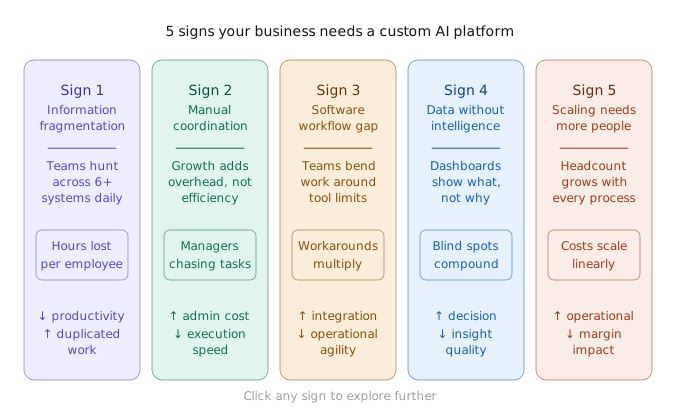
Sign 1: Your Teams Spend More Time Searching for Information Than Using It
This one is worth pausing on because it's so normalised that most organisations don't realise how expensive it actually is.
Picture a typical morning in a knowledge-intensive business. A department head needs a client update before a call that starts in forty minutes. Three different people get pinged — one in sales, one in operations, and one who was on the last project review. The salesperson has part of it in the CRM. Operations has the rest in a project tracking tool. The project review notes are in a shared drive somewhere, in a folder that was named logically by whoever created it and hasn't been easy to find since.
Forty minutes later, the information is assembled. The call goes well. And nobody stops to calculate what just happened: three people's time consumed, information scattered across multiple systems, the same search exercise that will be repeated next week and the week after.
This pattern doesn't usually feel like a crisis because it's so embedded in normal operations. It feels like how work works. But at the organisational level, it represents an enormous and largely invisible productivity drain — and it compounds directly with headcount. Ten people doing this occasionally is a nuisance. Five hundred people doing it daily is a structural problem with a measurable financial cost.
Where this typically shows up:
- New team members are taking weeks to locate where different types of information live
- Meetings structured around information retrieval rather than decision-making
- Important context is getting recreated from scratch because nobody can find the original
- Institutional knowledge tied to specific people rather than accessible to the team
Traditional software platforms — whether they're CRMs, ERPs, shared drives, or project management tools — were built to store and organise information. They were not built to surface it contextually, connect it across systems, or understand what a user is actually looking for. That gap is precisely where custom AI platforms create their most immediate operational value.
A purpose-built AI intelligence layer can turn fragmented organisational knowledge into something that surfaces when it's needed, rather than something that has to be manually excavated every time a question gets asked.
Sign 2: Growth Is Creating Friction Instead of Efficiency
There's a version of operational scaling that most businesses expect: as the company grows, processes become more efficient because there are more people to handle them and more resources to automate them. What actually happens in many organisations is the opposite. Growth creates more coordination requirements, more approval layers, more systems to synchronise — and the net result is that things slow down.
When a small team adds a new client, it's a conversation between two or three people. When an enterprise adds a client, it's a process involving account setup, CRM updates, onboarding workflows, billing system entries, compliance checks, and team notifications — and in most organizations, most of that happens through manual coordination.
The tell-tale sign of this problem isn't usually a single dramatic breakdown. It's the accumulation of small operational habits that emerge to compensate for missing automation:
- Status update meetings that exist purely because there's no system surfacing current status automatically
- "Reply all" email chains that function as a substitute for proper workflow coordination
- Managers spending significant portions of their week following up on tasks rather than making decisions
- Duplicate data entry because the system that tracks one thing doesn't connect to the system that tracks the related thing
This is the pattern that signals a business has outgrown its operational architecture. The workflows were designed for a smaller, simpler version of the organisation, and what was manageable at that scale has become a coordination tax that every team member pays daily.
Custom AI platforms address this by automating the coordination layer itself — not just individual tasks, but the entire web of triggers, notifications, status updates, and handoffs that currently depend on people remembering to do things. When that layer runs automatically, scaling stops producing administrative overhead and starts producing operational capacity.
Sign 3: Your Software Forces Your Team to Work Around It
This is a sign that rarely gets named clearly, but it's visible in almost every organisation that has been using the same software stack for more than two or three years.
It usually starts as a small thing. A field in the CRM that doesn't quite match how the sales team thinks about their pipeline, so they add a workaround column in a spreadsheet. A reporting tool that doesn't filter the way the operations team needs, so someone exports the data monthly and manipulates it manually. A process that the software technically supports, but in a way that's slow enough that people have developed an offline alternative.
Over time, these workarounds accumulate. The gap between how the software works and how the business works is filled with manual effort, informal processes, and institutional knowledge about "how we actually do it here." The official system becomes a record-keeping tool while the real work happens in spreadsheets and chat messages, and individual judgment calls.
At the industry level, this problem is most acute in environments where workflows are genuinely specific to the operational context:
| Industry | Why Generic Software Falls Short |
|---|---|
| Recruitment & Staffing | Candidate evaluation logic, sourcing workflows, and client-specific hiring criteria vary significantly across firms |
| Manufacturing | Production workflows, quality checkpoints, and shop floor processes are highly specific to each plant's setup |
| Logistics & Supply Chain | Route structures, vendor relationships, and compliance requirements differ across every operational environment |
| GCC Operations | Coordination between offshore delivery and global stakeholders requires workflows that generic tools weren't built for |
| Enterprise Knowledge Management | The structure of organisational knowledge varies enough that one-size-fits-all systems consistently miss the mark |
Generic AI tools are built to handle a large middle ground. They work for businesses whose workflows are close enough to standard that the gaps are manageable. The further a business's actual operations sit from that middle ground, the more the software becomes an obstacle rather than an enabler.
Custom AI platforms reverse this dynamic. Instead of the business adapting to the software, the software is built around the business — its actual workflows, its existing systems, its specific operational logic. The result is AI that fits rather than AI that compromises.
Sign 4: You Have More Data Than You Can Actually Use
This sign is deceptive because it looks, on the surface, like a data problem. It isn't. It's an intelligence problem.
Most businesses that have been operating for a few years have accumulated significant amounts of operational data. Transaction records, customer interaction histories, production logs, hiring outcomes, supplier performance data, and support ticket archives. It exists in various systems, it's technically accessible, and organisations occasionally generate reports from it.
But generating a report is not the same as extracting intelligence. A report tells you what the numbers were. Intelligence tells you what the numbers mean — which patterns are significant, which anomalies are worth investigating, which trends are developing before they become visible in the summary metrics.
The gap between what most businesses report and what they could know if their data were properly analysed is significant:
- A manufacturing company tracks scrap rates but doesn't know which specific production conditions consistently precede scrap spikes
- A recruitment firm tracks time-to-hire but hasn't connected that metric to which sourcing channels produce candidates that actually succeed in the role
- A logistics operation monitors delivery performance but hasn't identified the operational pattern that predicts which routes will generate delays next quarter
Each of these is a case where the data to answer the question already exists inside the business. The issue is that traditional reporting tools weren't built to ask the question — they were built to display numbers. And the difference between displaying numbers and understanding what they're telling you is exactly the space where AI-powered operational intelligence operates.
What the shift from reporting to intelligence actually enables:
- Pattern recognition across operational data that no human analyst would have the bandwidth to run manually
- Predictive signals that surface developing problems before they appear in performance dashboards
- Context-aware recommendations that connect what's happening in one part of the operation to what's likely to happen in another
- Institutional learning — the system gets more accurate the more operational data flows through it
This is a compounding advantage. Every month of operational data that flows through a proper AI intelligence layer makes the system's predictions more reliable. Organisations that start building this now will have a progressively widening lead over those that remain in reporting-only mode.
Sign 5: Every Stage of Growth Requires Proportionally More People
This is the most economically significant sign on this list, and in some ways the most difficult to confront — because it touches on organisational structure and resource allocation in ways that can feel politically sensitive.
The question to ask honestly is this: when the business grew significantly last year, did operational efficiency improve, or did operational complexity grow at roughly the same rate as revenue? If headcount grew proportionally with workload rather than disproportionately less — if every new capability or capacity required new coordinators, administrators, and operational staff to manage it — then the business is scaling linearly in a world where the competitive advantage increasingly goes to businesses that scale exponentially.
This isn't a commentary on the value of human expertise. It's a structural observation about what happens when operational growth depends on human coordination that could be systematically automated.
The distinction between healthy and problematic scaling:
| Scaling Pattern | What It Looks Like | What It Signals |
|---|---|---|
| Healthy AI-enabled scaling | Revenue and output grow faster than headcount | Intelligent infrastructure absorbing coordination overhead |
| Linear people-dependent scaling | Headcount grows at the same rate as operational load | Automation gap — processes running on human effort |
| Degrading scaling | Coordination overhead grows faster than output | Operational architecture has reached its ceiling |
Organisations in the second or third row of that table aren't necessarily doing anything wrong operationally. They may have excellent teams running well-designed processes. The limitation is structural — the processes themselves weren't designed to be automated, and the systems they run on weren't built to scale without proportional human intervention.
Custom AI platforms change this by automating the coordination, routing, processing, and decision-support functions that currently depend on manual effort. When those functions run automatically, the organisation gains the ability to grow operational output without growing administrative overhead at the same rate.
This is what "operational scalability" actually means in practice — not just the theoretical possibility of handling more volume, but the practical reality of being able to do so without the cost structure expanding proportionally.
The Common Thread Across All Five Signs
Looking at these five patterns together, the underlying dynamic is consistent: each represents a case where the operational complexity of the business has outpaced the intelligence infrastructure supporting it.
Generic software was adequate when the organisation was smaller, the workflows were simpler, and the data volumes were manageable. As each of those things grew, the gap between what the software could do and what the business needed widened — and human effort filled that gap, at escalating cost.
Custom AI development closes that gap by building intelligence infrastructure designed for the specific operational environment — the actual workflows, the real data structure, the genuine coordination requirements — rather than a standardised version of what those things might look like across industries.
This is exactly what builds. for AI-powered recruitment intelligence, for enterprise data intelligence for manufacturing and operational AI, and for conversation intelligence — each designed around the specific operational realities of its domain rather than a generic interpretation of what AI in that space should look like.
The businesses that recognise these five signs early and act on them before operational costs become structural tend to be the ones that scale effectively. Those who wait until the friction is undeniable often find that the gap they need to close has compounded significantly in the meantime.
Frequently Asked Questions
What is a custom AI platform, and how is it different from off-the-shelf AI tools?
A is built specifically around a business's actual workflows, data structures, and operational logic — rather than a generalised interpretation of what those things might look like across an industry. Off-the-shelf tools solve for the average use case. Custom platforms solve for the specific one, which becomes increasingly important as a business's operational complexity grows beyond what standard software handles well.
How do I know if my business needs AI automation or just better software? The simplest diagnostic is whether your current software forces workarounds. If teams are maintaining external spreadsheets to compensate for tool limitations, if coordination requires manual effort that software should handle, or if your data produces reports but not actionable insight — those are signals that better software alone won't solve the problem. AI automation addresses the intelligence layer, not just the storage and workflow layer.
Which industries benefit most from custom AI development in India?
Manufacturing, recruitment and staffing, logistics and supply chain, GCC operations, and enterprise knowledge management are among the highest-impact areas. These industries share a common characteristic: workflows are specific enough to the operational context that generic software consistently falls short, and the coordination complexity is high enough that intelligent automation creates significant measurable value.
What does scaling through AI infrastructure actually mean in practice?
It means operational output can grow without proportional growth in administrative headcount. AI handles coordination, routing, classification, reporting, and decision-support functions automatically — which means the business can expand its capacity without expanding the overhead of managing that capacity manually.
How long does it typically take to implement a custom AI platform?
Focused implementations addressing specific operational problems — a recruitment intelligence system, a manufacturing data layer, a knowledge management platform — typically deploy in six to twelve weeks with the right development partner. Broader enterprise programs spanning multiple business units take longer. Scope clarity at the start of the engagement is the single biggest factor in keeping timelines predictable.
A Final Thought
The businesses that move fastest in the next few years won't necessarily be the ones with the largest AI budgets. They'll be the ones that identify which specific operational problems AI infrastructure actually solves — and build around those problems precisely rather than adopting AI broadly and hoping for impact.
If any of the five signs above feel familiar, that's usually the starting point worth examining. The operational friction that feels like a day-to-day annoyance is often the clearest indicator of where intelligent infrastructure would create the most meaningful change.
Learn how AlphaNext Technology Solutions builds custom AI platforms around real operational environments at