

Every business conversation contains more useful information than anyone in the room manages to capture.
Think about the last important meeting you sat through. Someone said something specific about a client's concern halfway through. A decision was made verbally that nobody wrote down precisely. An action item was mentioned in the last five minutes when people were already mentally moving to the next thing. And by the time the meeting notes arrived — if they arrived — the nuance was gone, smoothed into a summary that captured the outcome but lost the reasoning.
This is not a new problem. Businesses have always generated operational intelligence through conversation and lost most of it the moment the call ended. What's changing now is that the tools to fix this have become genuinely good — and the industries adopting them early are discovering that the value goes well beyond note-taking.
Modern AI transcribers have evolved into something considerably more useful than speech-to-text. They capture conversations in real time, generate structured summaries, extract action items, organise knowledge automatically, support multilingual discussions, and integrate directly with enterprise workflows. The conversation stops being a temporary event and starts being a permanent, searchable operational record.
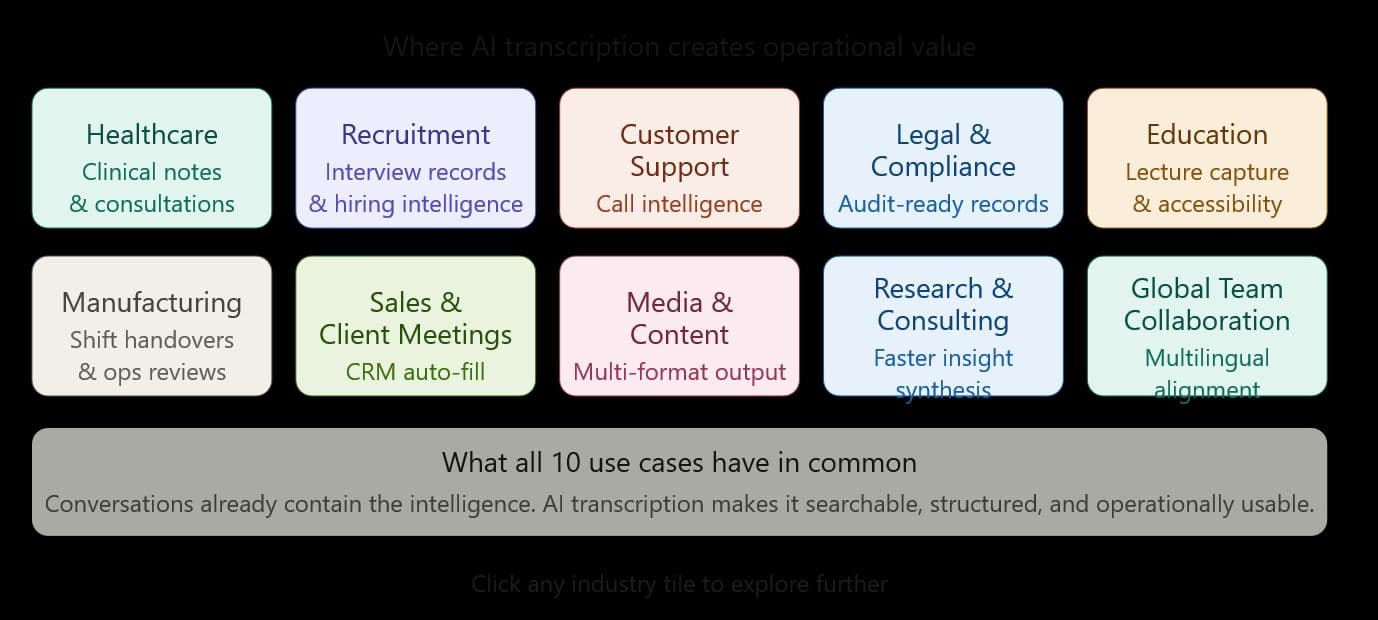
Here's where that shift is making the biggest practical difference.
Quick Reference: Industry Impact at a Glance
| Industry | Primary Pain Point Solved | Operational Outcome |
|---|---|---|
| Healthcare | Documentation burden on clinical staff | More patient time, more accurate records |
| Recruitment | Inconsistent interview notes across teams | Structured hiring intelligence, better decisions |
| Customer Support | Lost context between agents and calls | Faster resolution, stronger quality monitoring |
| Legal & Compliance | Manual transcription of sensitive discussions | Audit-ready records, reduced documentation risk |
| Education | Inaccessible lecture content for diverse learners |
1. Hospital and Healthcare Consultations
Healthcare professionals are in an unusual position: their primary job is patient care, but a significant portion of their working day goes toward documenting it. Studies consistently show that clinicians spend more time on administrative tasks than most patients realise — and manual documentation is one of the largest contributors.
The problem isn't that healthcare professionals are slow. It's that reconstructing a fifteen-minute consultation from memory, after seeing eight more patients, while updating three different record systems, is genuinely difficult. Details get compressed. Nuance disappears. And when documentation is incomplete, the downstream effects on treatment continuity and clinical accuracy can be serious.
address this at the point of conversation rather than after it.
During patient consultations, AI transcription systems capture the discussion in real time and generate structured clinical notes automatically — which means a doctor can stay focused on the patient during the appointment rather than splitting attention between listening and writing.
Where this creates the most immediate value:
- Multilingual patient populations where symptoms are explained in regional languages or mixed-language communication styles
- High-volume outpatient environments where documentation backlog accumulates daily
- Specialist consultations with complex terminology that manual note-taking consistently undersells
- Telehealth environments where the full record is the only record — there's no physical examination to supplement incomplete notes
The accuracy benefit compounds over time. When clinical records reflect what was actually said rather than a reconstructed summary, they become more useful for follow-up consultations, specialist referrals, and long-term care coordination.
2. Recruitment Interviews and Hiring Operations
A single hiring process involves more conversations than most people outside of recruiting realize. A recruiter screening call, a technical interview, an HR discussion, a panel review, a leadership conversation, a reference call — each one generates information that's supposed to inform the final hiring decision. The problem is that by the time the decision meeting happens, each person in the room is working from a different set of notes in different formats, filtered through different memories.
This creates inconsistency. Not because the hiring team is careless, but because the information architecture of the process was never designed to support consistent evaluation across multiple conversations.
AI transcription changes this structurally. Rather than asking recruiters to simultaneously conduct an interview and capture it accurately — two tasks that actively compete with each other for cognitive attention — the system handles documentation while the recruiter focuses entirely on the conversation.
What this produces in practice:
- Structured interview summaries that every stakeholder can review, not just whoever was in the room
- Objective records that support consistent candidate evaluation across different interviewers
- Searchable archives of past interviews that help calibrate assessment criteria over time
- Better collaboration on remote and distributed hiring where stakeholders rarely overlap on calls
For organizations running high-volume hiring operations, the compounding benefit is significant. Every interview produces a record that can be referenced, compared, and learned from — rather than a set of notes that expires the moment the next candidate comes in.
3. Customer Support and Call Center Operations
Customer support calls are one of the richest sources of operational intelligence in any business. Recurring complaints reveal product issues before they appear in formal reports. Escalation patterns reveal process failures that internal metrics don't capture. Customer language around frustration often identifies the actual problem more precisely than any survey response.
Most of this gets lost.
Support agents summarize calls manually after they end — under time pressure, while the next ticket is already queued. The summary captures the outcome but rarely captures the signal. And when cases escalate between agents, context gets reconstructed from whatever was written rather than from what was actually said.
AI transcribers solve this across multiple levels simultaneously.
The operational improvements stack up quickly:
- Real-time transcription eliminates post-call documentation lag
- AI-generated summaries capture issue context, sentiment, and escalation triggers consistently
- Searchable call archives let managers identify patterns across hundreds of interactions, not just the ones they personally reviewed
- New agents get full conversation history on transferred cases rather than a two-sentence summary
- Quality monitoring becomes proactive rather than retrospective — issues surface in the data before they appear in customer churn
The shift from call documentation to call intelligence is a meaningful one. It turns the support function from a cost center into an insight engine that consistently surfaces product, process, and experience issues that other feedback channels miss.
4. Legal and Compliance Documentation
In legal environments, the cost of imprecise documentation isn't just operational — it's material. A client consultation that captures the gist of an instruction isn't the same as one that captures the exact instruction. A compliance discussion that records the conclusion without the reasoning behind it isn't the same as one that documents both. These distinctions have real consequences in professional practice.
The traditional response has been to invest more human time in documentation — more careful note-taking, more thorough write-ups, more review cycles. The problem is that this approach scales linearly with workload. More matters, more time. And in legal and compliance environments where matter volumes are already high and professional time is expensive, that math doesn't work indefinitely.
AI transcription breaks the linear relationship between documentation quality and human time investment.
Meetings and consultations can be transcribed automatically with timestamped records, organized summaries, and searchable archives — without any additional effort from the professionals in the room. The documentation quality improves while the documentation burden decreases.
For compliance teams specifically, the audit readiness dimension is significant. When every relevant discussion is automatically recorded, organized, and searchable, preparing for regulatory reviews becomes a retrieval exercise rather than a reconstruction project. The records are already there, in the format that supports compliance verification, rather than needing to be assembled under time pressure when an audit arrives.
5. Education and Online Learning
The classroom has changed in ways that expose a limitation that always existed but was easier to overlook when everyone was physically present: lectures are temporary. If you missed something, or didn't fully understand it when it was said, your only option was to ask — and in a lecture hall of two hundred people, that's not always practical.
Digital and hybrid learning environments have made this tension more visible. Students joining remotely, students in different time zones accessing recorded lectures asynchronously, students whose first language isn't the language of instruction — all of them need the same content to be genuinely accessible, not just technically available.
AI transcription makes lecture content searchable, revisable, and language-accessible in ways that recordings alone don't.
What changes for different stakeholders:
- Students can search a lecture by topic rather than scrubbing through video trying to find the relevant section
- International students can access translated transcripts without waiting for institutional translation services
- Students with hearing difficulties gain a reliable alternative to audio content
- Instructors can identify which parts of their lectures generate the most annotation and confusion — genuine pedagogical feedback that no survey captures
For institutions managing large-scale digital education programs, the operational benefit of searchable lecture archives compounds over time. Content becomes reusable across cohorts, searchable across topics, and genuinely accessible rather than just technically stored.
6. Manufacturing and Industrial Operations
Manufacturing plants produce two kinds of information. The first kind is machine data — sensor readings, production counts, quality measurements, machine states — and most facilities have invested heavily in capturing this. The second kind is human communication — shift handovers, production reviews, maintenance discussions, safety meetings — and most facilities are still handling this with manual notes or nothing at all.
This asymmetry creates a visibility gap that shows up in specific, costly ways. A maintenance issue that was discussed in a shift handover doesn't make it into the maintenance system because nobody formally logged it. A quality concern raised in a production review doesn't get tracked because the meeting notes were incomplete. A safety observation made during a floor walk doesn't get documented because the process for doing so takes more time than the observation itself.
AI transcription addresses the second kind of information with the same systematic approach that most plants already apply to the first.
In Industry 4.0 environments, where digital transformation with AI is already driving investment in connected operational systems, conversation intelligence fits naturally into the broader architecture. Shift handover discussions become structured records that link to maintenance workflows. Production review conversations become searchable operational history. Safety meeting outcomes become trackable commitments rather than verbal agreements that depend on individual memory.
The value isn't just documentation — it's operational continuity. Information that currently evaporates when a shift ends starts flowing forward, creating a consistent operational record that supports better decision-making at every level.
7. Sales Calls and Client Meetings
Sales professionals face a specific version of the documentation problem. Every client conversation is simultaneously high-stakes and high-volume — it requires full presence and careful attention, but it also generates information that needs to be captured accurately for the CRM, for the account team, for the follow-up, and for the next conversation six weeks later.
Most salespeople resolve this tension imperfectly. They either take notes during the call and miss parts of the conversation, or they stay fully present and write everything up from memory afterward — losing precision in the process. Neither approach produces the quality of record that complex, relationship-driven sales processes actually require.
AI transcribers eliminate the trade-off.
Modern AI meeting intelligence platforms handle the documentation layer automatically:
- Full conversation transcript available immediately after the call ends
- AI-generated summary capturing client concerns, commitments, and agreed next steps
- Action items extracted and ready to assign without manual review
- CRM integration pushing relevant information directly to the account record
The downstream effects compound in useful ways. Follow-ups go out faster because the summary is already written. Account handoffs are smoother because the full context is in the system rather than in the departing salesperson's memory. Deal reviews are more accurate because the record reflects what was actually said rather than what the team remembers saying.
8. Media, Podcasts, and Content Production
Content production teams deal with a specific operational bottleneck: the raw material is audio and video, but most of what they need to do with it requires text. Blog posts, show notes, social captions, subtitles, newsletter content, SEO pages — all of it starts with something someone said on a microphone, and all of it currently requires a manual conversion step that slows the pipeline and limits how much content can realistically be produced.
AI transcription changes the economics of this pipeline significantly.
A single hour-long podcast episode, once transcribed automatically, becomes the source material for multiple content formats simultaneously:
- Blog post drawing on the key discussion points
- Social media captions pulling quotable moments
- Newsletter summary with links to the full episode
- Subtitle files for the video version
- SEO-optimized show notes with searchable timestamps
- Short-form clip scripts based on the strongest segments
The production team that previously spent hours manually transcribing before they could begin repurposing can now begin repurposing immediately. For content-heavy organizations — media companies, agencies, enterprise learning and development teams, creator businesses — this isn't just an efficiency gain. It's a fundamental change in how much content can be produced from the same amount of recorded material.
9. Research, Consulting, and Strategy Workshops
Consulting and research environments are built on gathered intelligence — stakeholder interviews, discovery workshops, expert conversations, advisory sessions. The quality of the deliverable depends heavily on how much of that intelligence makes it from the conversation into the analysis.
The problem is synthesis speed. An engagement that involves twenty-five stakeholder interviews generates somewhere between fifteen and twenty-five hours of recorded content. Extracting the consistent themes, the outlier perspectives, the specific language that stakeholders used to describe problems — all of it requires going back through the recordings, which takes time that most engagement timelines don't generously accommodate.
AI transcription compresses this cycle significantly.
What the workflow looks like with AI transcription in place:
- Interviews are transcribed automatically as they conclude
- Searchable transcripts allow cross-interview theme identification in minutes rather than hours
- AI-generated summaries give the analysis team a structured starting point for each conversation
- Specific quotes and observations can be located by topic across the full dataset rather than requiring sequential review of each recording
For consulting firms where engagement timelines are tight and deliverable quality is the primary differentiator, faster synthesis translates directly into better work — more time spent on insight development, less time spent on information retrieval.
10. Multilingual Global Team Collaboration
Distributed teams have normalized something that, when you look at it directly, creates significant operational friction: regularly scheduled meetings where participants don't all share a first language, conducted in a working language that some people are more comfortable with than others, producing informal records that reflect the language comfort of whoever wrote them.
The result is that information flows inconsistently. The participants who are most fluent in the meeting language tend to dominate the record. Nuances expressed in less comfortable languages get smoothed out. And the meeting notes that go out afterward represent one version of the conversation rather than all of it.
For GCC operations, multinational enterprises, and globally distributed teams — this friction accumulates into a meaningful coordination cost over time.
AI-powered multilingual transcription addresses this at the source.
What changes operationally:
- Conversations are captured accurately regardless of which participants are most comfortable in the working language
- Translated records make meeting content accessible to team members who weren't in the room
- Searchable multilingual archives mean that knowledge generated in regional-language discussions doesn't stay siloed
- Distributed teams operate from a consistent version of every conversation rather than fragmented interpretations
The alignment benefit is real and compounding. When every team member — regardless of location or language — has access to the same accurate record of every important conversation, the operational gap between global teams narrows considerably.
Why AI Transcribers Are Evolving Into Intelligence Platforms
There's a broader pattern running through all ten use cases above. In every industry, the underlying problem isn't that conversations don't happen. It's that the information in those conversations doesn't survive in usable form long enough to become operational knowledge.
Traditional responses to this problem — better note-taking, longer meeting summaries, more rigorous follow-up processes — treat it as a human effort problem. AI transcription treats it as a systems problem. The conversation gets captured completely, organized automatically, made searchable permanently, and integrated directly with the workflows where the information needs to land.
Modern AI transcription platforms now combine:
- Real-time multilingual transcription across 50+ languages
- AI-generated summaries focused on decisions and next steps
- Automatic action-item extraction and assignment
- Noise cancellation for hybrid and remote meeting environments
- Searchable meeting archives that build institutional knowledge over time
- Workflow integrations with CRM, ERP, project management, and enterprise systems
This is the shift from transcription as a documentation tool to transcription as an operational intelligence layer. The conversation doesn't just get recorded — it gets structured, connected, and made useful.
How Echo by AlphaNext Fits Into This
is built for exactly this shift.
Rather than functioning as a basic recording tool with a summary feature attached, Echo is designed as an enterprise-grade multilingual conversation intelligence platform. Real-time transcription across 50+ languages, AI-powered meeting summaries, smart action-item extraction, noise-cancelling AI processing, workflow integrations, and searchable meeting intelligence — all designed to fit into the operational environments where enterprise teams actually work.
For GCCs coordinating across India and global parent organizations, for recruitment teams running high-volume hiring operations, for manufacturing operations where shift communication needs to become structured data, for sales teams whose CRM accuracy depends on post-call documentation quality — Echo is built around the specific workflows where conversation intelligence creates the most measurable operational value.
The Underlying Point
Every organization on this list — healthcare, recruitment, legal, manufacturing, sales, research, and the rest — is already generating the intelligence it needs to operate more effectively. The conversations are happening. The insights are being expressed. The decisions are being made.
What's been missing is the infrastructure to capture all of it reliably, organize it intelligently, and make it usable beyond the moment the call ends.
That infrastructure now exists. And the businesses building it into their operations earliest are the ones that will carry the least operational knowledge loss going forward — and compound the most value from every conversation their teams have.
See how Echo transform s your team's conversations into structured operational intelligence at