

In 2026, businesses are under constant pressure to do more with fewer resources. Operational expenses are rising, teams are stretched thin, and customers expect faster service. For many enterprises, the challenge is not just the growth, but it’s sustainable growth
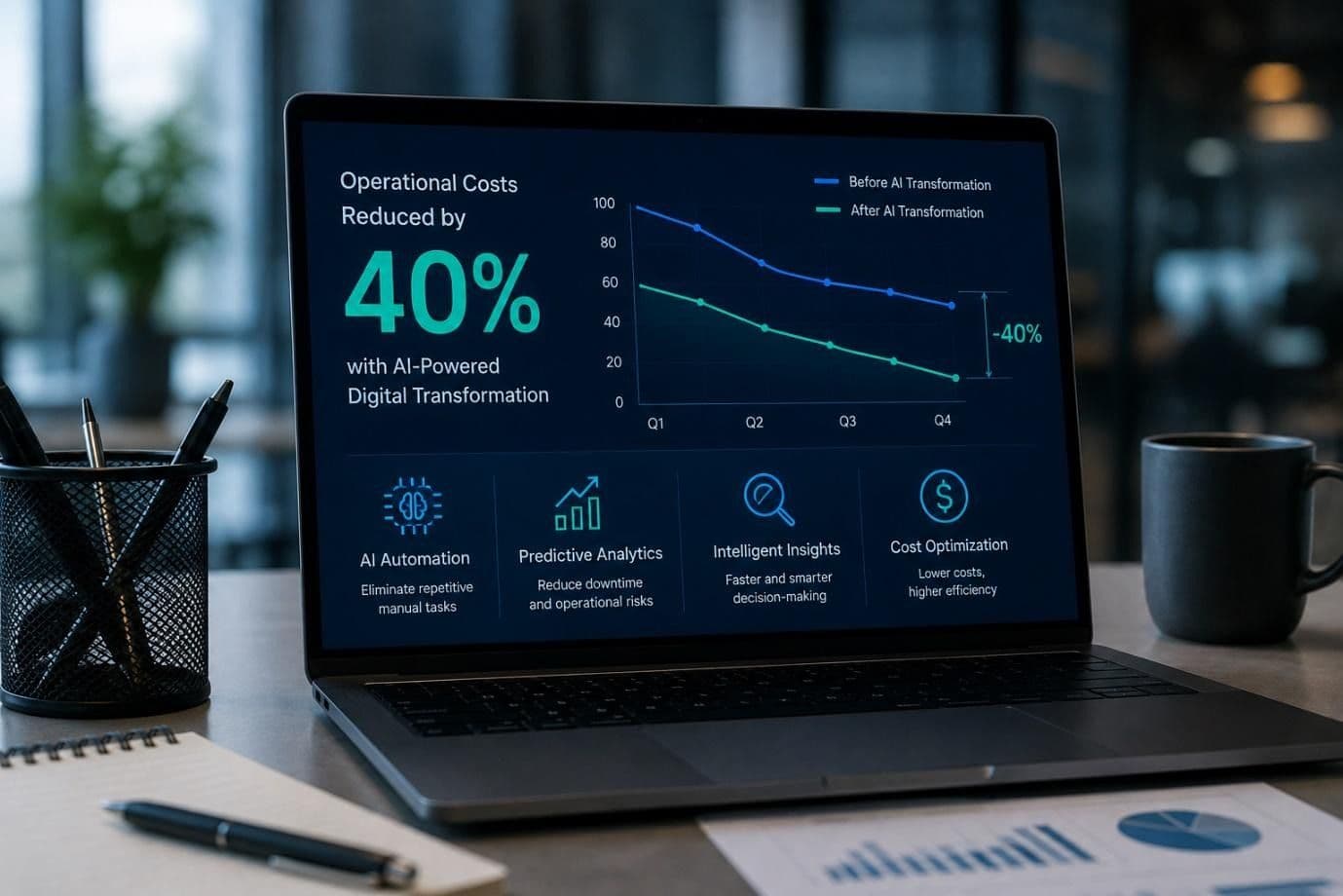
Across industries, companies are now using AI solutions to automate repetitive tasks, improve employee productivity, streamline operations, and make faster business decisions. And the results are difficult to ignore. Many reports state that enterprises implementing AI automation strategically are reducing operational costs by up to 40% while improving efficiency across departments.
The biggest shift? Businesses are realising that AI is not simply a tool for automation. It’s becoming the operational backbone of modern enterprises.
Digital transformation with AI has moved from a future initiative to an immediate operational priority. Not because AI is trending, but because the math of sustainable growth without proportional overhead increase increasingly depends on it.
What is changing in the Digital Transformation Conversation?
A few years ago, digital transformation simply meant moving infrastructure to the cloud, digitising paper processes, and replacing legacy systems with modern SaaS platforms. These investments mattered, and many still do. But they left a specific gap that most organisations are now actively trying to close.
The digitisation wave created better storage and better interfaces. It didn't create intelligence. Data moved from filing cabinets into cloud systems. Workflows moved from paper to digital tools. But the coordination between those workflows — the handoffs, the approvals, the information retrieval, the decision support — still depended heavily on human effort in most organisations.
Modern enterprises now want systems that go further. They want platforms that can automate repetitive work, not just mechanically but contextually, analyse business data in real time rather than in periodic reports, reduce the human error that accumulates in high-volume manual processes, and support employees with intelligent assistance rather than just digital storage.
This is where and are creating operational change that earlier phases of digital transformation couldn't. The goal isn't replacing the workforce. It's redirecting workforce capacity from coordination overhead toward the judgment, creativity, and relationship work that actually requires human attention.
Where the 40% Cost Reduction Actually Comes From
When enterprises talk about reducing operational costs by 40% through AI, it's worth being specific about what that means — because it doesn't come from one dramatic change. It accumulates across multiple operational layers simultaneously.
| AI Implementation Area | Operational Impact | Typical Cost Category Affected |
|---|---|---|
| Workflow automation | Reduced manual coordination overhead | Labour, administrative processing |
| AI-powered customer support | Lower per-ticket handling cost | Customer service staffing |
| Predictive analytics | Fewer costly operational surprises | Downtime, emergency procurement |
| Enterprise AI search | Faster information retrieval | Productivity, project timelines |
| AI recruitment tools |
None of these individually accounts for 40%, but the compounding effect of improving across all of them simultaneously does. The organisations seeing the largest gains tend to share one characteristic: they approached AI as operational infrastructure rather than as a collection of individual tools. The gains compound when AI capabilities work together across workflows rather than operating in isolated silos.
How AI Automation Is Transforming Enterprise Operations
Eliminating Repetitive Coordination Overhead
The most immediate and measurable impact of AI workflow automation is on the category of work that consumes significant organisational capacity without requiring genuine human judgment — the coordination overhead that exists in every enterprise and grows faster than headcount when left unmanaged.
Invoice management, HR onboarding sequences, document processing, IT ticket handling, scheduling coordination, and internal reporting — these processes share a common characteristic. Each step is straightforward. The complexity and cost come from the volume, the coordination between steps, and the manual effort required to keep workflows moving when systems don't communicate automatically.
Traditional automation tools address this partially. They handle the predictable, rule-based portions of workflows and break down when conditions vary from the expected pattern. AI-powered automation handles variability differently — by understanding context rather than just matching conditions. When an invoice arrives with a format variation the rule-based system has never encountered, AI processes it correctly. When an onboarding workflow needs to adapt because a hire's start date has shifted, AI adjusts without manual intervention.
This is why enterprises that have moved from generic automation software to custom AI platform development consistently report larger operational improvements than those that stuck with rule-based tools. The AI handles the middle — the routine but variable work that previously required constant human oversight to manage edge cases.
Making Enterprise Knowledge Instantly Accessible
There's a category of operational cost that doesn't appear in any single budget line but is visible when you watch how knowledge workers actually spend their time. It's the hours consumed locating information that exists somewhere inside the organization but isn't accessible when it's needed.
Employees navigate disconnected systems, dig through email archives, search shared drives organized by someone who's no longer at the company, and ultimately ping colleagues to ask if they know where something is. Across an organization of any significant size, this friction adds up to substantial lost productivity every week — time that isn't captured in any efficiency report but shows up as slower project delivery, longer decision cycles, and onboarding timelines that stretch further than they should.
AI-powered enterprise application development addresses this by building intelligent knowledge layers that make information retrievable through natural language rather than through system navigation. Instead of opening four applications and performing keyword searches in each, an employee asks a question and receives an accurate, source-linked answer drawn from the organisation's actual current documentation. The information was always there. The AI makes it usable without the overhead of finding it.
For growing organisations in particular, where the knowledge base is expanding faster than any individual can track, this capability shifts from useful to essential.
Reducing Customer Support Costs Without Reducing Service Quality
Customer support is consistently one of the highest operational cost areas in enterprise organisations — and one of the areas where AI automation creates the most visible, measurable improvement.
The volume of repetitive customer interactions — order status inquiries, basic troubleshooting, account information requests, FAQ responses, appointment coordination — is substantial in most businesses and requires significant staffing to manage at acceptable response times. AI-powered support systems handle this volume automatically, consistently, and at a fraction of the cost of equivalent human capacity.
Beyond cost, the quality dimension matters. AI customer support systems respond instantly rather than during business hours. They handle multilingual conversations without requiring dedicated language-specific staffing. They don't have bad days or vary in tone based on how many difficult calls preceded the current one. For customers, these characteristics often translate to a better experience than the human alternative — particularly for routine interactions where speed and accuracy matter more than relationship depth.
Human support teams, freed from repetitive interactions, concentrate on the complex customer situations where empathy, contextual reasoning, and genuine problem-solving create value that AI systems can't replicate. The result is both lower cost and better service for the interactions that matter most.
Predictive Intelligence That Changes the Cost of Operational Surprises
Reactive operations are expensive operations. When an equipment failure stops a production line, the cost isn't just the repair — it's the production loss, the downstream supply chain impact, the emergency procurement premium, and the customer commitments that can't be met on schedule. When inventory runs short unexpectedly, the cost isn't just the lost sale — it's the expedited shipping, the customer relationship damage, and the operational scramble that disrupts other workflows.
changes the economics of operational surprises by identifying them while they're developing rather than after they've materialised. Manufacturing businesses can anticipate equipment failures based on performance signatures that precede breakdown. Logistics operations can identify supply chain disruptions before they affect delivery commitments. Retail and e-commerce businesses can forecast demand shifts based on leading indicators rather than reacting after inventory positions are already wrong.
For industries where unplanned disruptions carry high costs — manufacturing, logistics, healthcare, financial services — this predictive capability delivers ROI that's substantial and relatively straightforward to quantify. Fewer emergencies mean lower emergency costs. Earlier visibility means more response options. Proactive management is consistently less expensive than reactive management at every operational scale.
Why Enterprises Are Moving Beyond Generic AI Tools
Most organizations begin their AI journey with publicly available tools. The barrier to entry is low, the setup is fast, and the initial results are often encouraging enough to build internal appetite for further investment.
The limitations become apparent as operational requirements grow more complex. Generic AI platforms are designed for the broadest possible user base, which means they're optimized for common use cases rather than specific operational contexts. An enterprise with unique workflow logic, specific compliance requirements, industry-particular data structures, and integration dependencies across a complex technology stack quickly finds that generic tools require the organization to adapt its operations to the software rather than the reverse.
Custom AI development inverts this relationship. The AI system is built around how the business actually operates — its real workflows, its existing technology infrastructure, its specific data environment, its particular compliance obligations. The result is an AI system that fits the operational reality rather than an operational reality simplified to fit the AI.
The operational advantages of custom AI over generic tools:
- Integration with existing enterprise systems — ERP, CRM, HRMS, industry-specific platforms — built around how those systems actually work rather than what standard connectors support
- AI models trained on the organisation's own historical data rather than industry-average patterns, which produce recommendations and predictions calibrated to this business's specific operational context
- Workflow logic that reflects the genuine complexity of the organisation's processes, including the edge cases and exceptions that define how the business actually runs
- Security and governance architecture designed around the specific compliance requirements of the organisation and its industry, rather than the lowest-common-denominator model that generic platforms must accommodate across all their customers
- A system that improves continuously as more of the organisation's operational data flows through it — creating a compounding accuracy advantage that widens over time
For enterprises focused on long-term operational advantage rather than short-term automation wins, this difference in approach creates meaningfully different outcomes over the life of the investment.
Why India Has Become a Global Center for Enterprise AI Development
The global demand for AI development capability has grown faster than most markets can supply it. India has emerged as one of the most significant sources of that capability for good reasons that go beyond the cost efficiency argument that historically dominated the outsourcing conversation.
The engineering talent depth in AI software development, enterprise integration architecture, and production AI system design has grown substantially. Indian AI development companies are building production-grade enterprise systems — not proof-of-concept demos or feature additions to existing platforms, but working operational AI systems that global businesses depend on daily across recruitment, manufacturing, logistics, knowledge management, and communication intelligence.
For enterprises evaluating AI development partners, the capabilities available from leading AI development companies in India in 2026 include strong enterprise AI engineering, scalable technical teams capable of sustaining complex programs over time, faster development cycles compared to markets where AI talent is scarce and expensive, and accumulated experience with the specific operational complexity of enterprise AI deployment that only comes from having shipped systems at production scale.
The combination of technical depth, development economics, and enterprise deployment experience is drawing enterprise AI investment to Indian development firms from organizations across North America, Europe, the Middle East, and Southeast Asia — and the trajectory of that investment suggests the trend is early-stage rather than peaking.
How AlphaNext Technology Solutions Helps Businesses Scale With AI
approaches enterprise AI development from an operational rather than a technology-first perspective — starting with how businesses actually work and building AI systems around that reality rather than deploying generic platforms and hoping they fit.
The company's platform addresses the enterprise knowledge accessibility problem directly — transforming fragmented organisational information into a searchable AI-powered intelligence layer where employees retrieve accurate, current knowledge through natural language queries rather than system navigation. For growing organisations where information fragmentation is an active operational cost, this capability creates immediate and measurable productivity improvement.
Beyond Alpha Hive, AlphaNext supports enterprises through custom AI platform development, AI-powered enterprise application development, AI automation services, and generative AI integration — with for recruitment intelligence, for conversation intelligence, and for manufacturing and operational intelligence, each representing the workflow-first design philosophy applied to specific operational domains.
The consistent thread across these platforms is that AI creates lasting operational value when it's built around how a specific business actually operates — not when it's deployed as a generic capability and expected to produce enterprise-specific outcomes.
The Future of Enterprise Operations Is Already Being Built
The enterprises creating the strongest competitive positions in 2026 are not necessarily the ones experimenting with the most AI tools. They're the ones that made a decision — some of them eighteen months ago, some of them more recently — to treat AI as operational infrastructure and invest accordingly.
The gap between these organisations and the ones still running primarily on manual coordination and disconnected software is beginning to show up in operational metrics. Lower cost per transaction. Faster decision cycles. Higher quality at scale. Better customer experience without proportional staffing increases. These advantages compound over time as AI systems accumulate organisational learning and become more accurate and more integrated with every operational cycle.
The 40% cost reduction figure that opens this article isn't a projection for a distant future. It's a reported outcome from enterprises that made the infrastructure investment and built AI into how they actually operate. The path to that outcome is specific: strategic rather than reactive AI adoption, workflow-first system design, proper data and integration architecture, scalability planning from day one, and ongoing optimisation rather than one-time deployment.
Organisations that start building toward this model now are doing so while the competitive differentiation is still meaningful. The window for building an AI-native operational advantage that's genuinely difficult for competitors to replicate is open — but it doesn't stay open indefinitely.
Explore how AlphaNext Technology Solutions helps enterprises build AI-powered operational systems that reduce costs and scale efficiently at