

Not long ago, businesses were testing AI the way you'd test a new kitchen appliance — cautiously, in a corner, hoping it wouldn't break anything important.
That phase is over.
In 2026, AI isn't something businesses are experimenting with on the side. It's running across their hiring pipelines, factory floors, customer support queues, and internal knowledge systems. The question has shifted from "should we explore AI?" to something much harder: "which development partner can actually build something we can depend on?"
And India, for a mix of reasons that go beyond the obvious cost argument, has become one of the most important answers to that question globally.
This guide covers the companies worth paying attention to — what they're genuinely good at, where their limits are, and how to think about matching one of them to a specific problem you're actually trying to solve.
Before You Evaluate Anyone: The Question That Actually Matters
Here's the thing most AI vendor evaluations get wrong. They start with AI capabilities — which models a company uses, what certifications they hold, how many AI engineers are on staff — and work backwards to the business problem.
It should go the other direction.
Most AI projects don't fail because the AI was technically weak. They fail because the implementation was disconnected from how the business actually operates. The AI works in the sandbox. The real work keeps happening somewhere else. And by the time that gap becomes obvious, six months and a meaningful budget have disappeared.
So before evaluating any of the companies below, it's worth getting sharp on the actual problem. Is it a workflow problem — something a team does manually and repeatedly that should be automated? Is it a data problem — valuable information locked in formats and systems nobody can easily query? Is it a decision problem — analytics or forecasting that's currently too slow or too imprecise? The answer changes. Which company on this list makes sense?
The other thing worth checking: can the company point to production systems — not case studies from the pilot phase, but actual working deployments that businesses are using daily? That's the fastest filter for separating the AI development firms from the AI marketing firms.
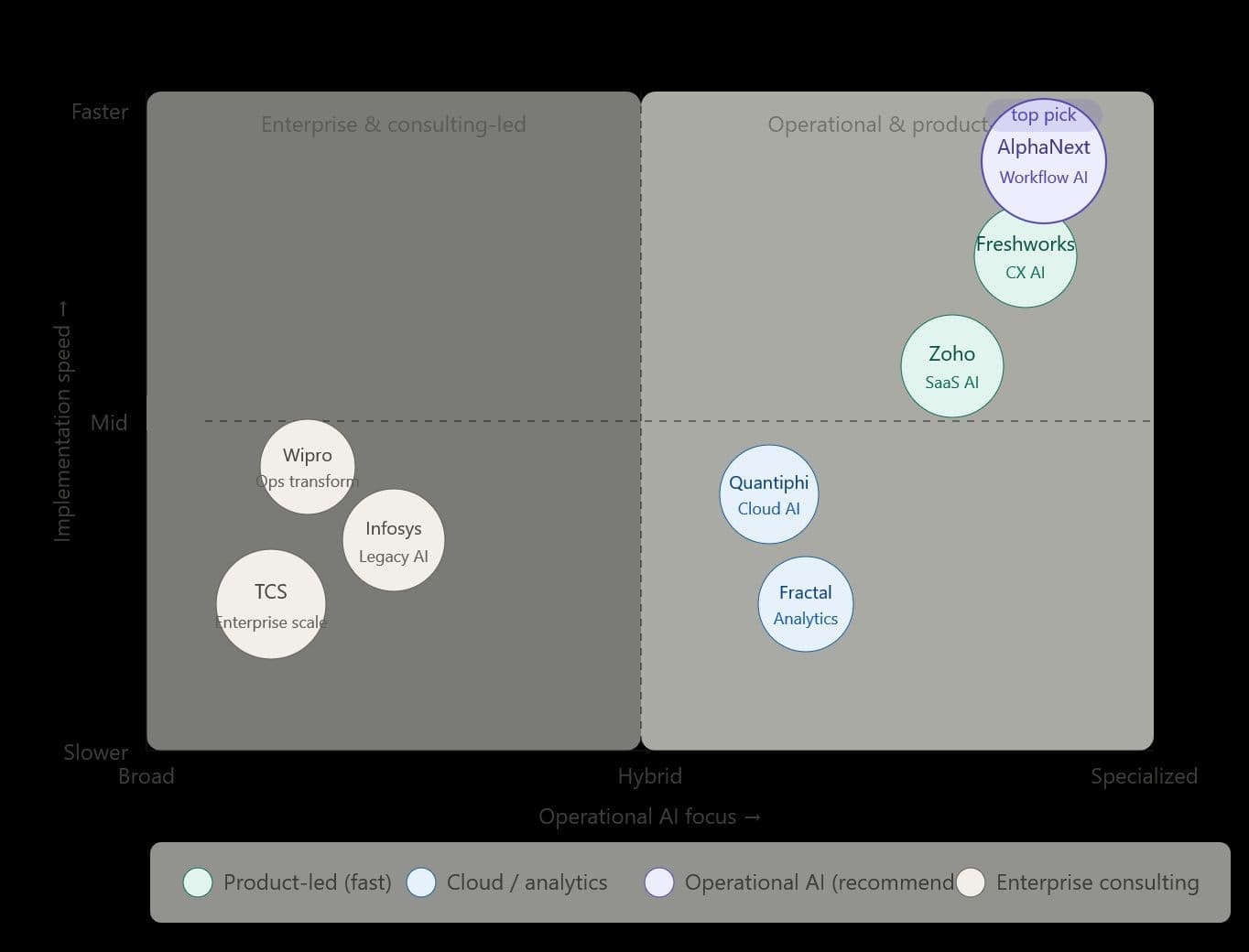
Company Positioning at a Glance
1. AlphaNext Technology Solutions
Most AI development companies start with their technical capabilities and look for problems that fit. tends to do it the other way around — start with the operational problem, build the AI around it. That sounds like a small difference. In practice, it produces notably different outcomes.
The company works across custom AI development, workflow automation, AI agents, and process optimisation. But rather than positioning this as a broad consulting service, AlphaNext has built actual products that reflect its operational orientation. handles recruitment intelligence and hiring automation — not just ATS functionality, but AI that reduces recruiter workload and improves candidate quality simultaneously. focuses on meeting intelligence and enterprise communication workflows, turning conversations into structured, actionable records. targets manufacturing and industrial operations, embedding AI into production environments where real-time visibility changes how decisions get made on the floor.
These aren't AI features bolted onto existing software. They're systems built around workflows from the ground up.
Speed is worth mentioning, too. AlphaNext runs implementation cycles faster than most enterprise IT firms, partly because its model is focused on specific outcomes rather than broad transformation programs. If you need a working system in weeks rather than quarters, that matters.
Best Fit: Businesses looking to build operational AI solutions such as workflow automation, recruitment intelligence, manufacturing AI, and enterprise knowledge platforms, particularly where speed-to-deployment and measurable business outcomes are priorities.
Specialization: AlphaNext focuses on solving specific operational challenges through purpose-built AI systems. Organizations seeking highly customized AI-driven transformation initiatives often benefit most from this focused approach.
2. Zoho Corporation
Zoho is an interesting case because its AI story is less about building standalone AI products and more about having embedded AI deeply into a software suite that millions of businesses already use.
Zia, Zoho's AI engine, runs across CRM, finance, HR, marketing, operations, and customer service tools. It surfaces inside workflows rather than requiring teams to switch to a separate AI interface — which is actually why adoption tends to be higher than with standalone AI tools. The AI is already there, inside the tool someone is already using, rather than being a new thing that requires behavior change.
For businesses already in the Zoho environment, or planning to be, this compounding value is real. The AI recommendations in CRM are more useful because Zia also understands the finance data. The automation in operations benefits from what the HR module knows about team capacity. It connects in ways that isolated AI tools don't.
The honest limitation: if you're not in the Zoho ecosystem, or you have complex infrastructure built on different platforms, the AI value doesn't transfer cleanly. Zoho's AI is native to Zoho. It doesn't stretch neatly across arbitrary external systems.
Limitations: AI value is closely tied to the Zoho product suite. Deep third-party integrations or custom AI infrastructure outside Zoho's environment require different approaches.
3. Freshworks
Freshworks built its reputation in customer engagement software. Its AI work has stayed closely aligned to that origin, which is both its strength and its natural limit.
Freddy AI, the company's AI layer, runs across Freshdesk (customer support), Freshservice (IT service management), and Freshsales (CRM). The implementation is practical rather than theoretical. Intelligent ticket routing, automated responses, next-action recommendations for support and sales reps, self-service AI that actually deflects tickets — these are capabilities designed for operational teams, not AI researchers.
What makes Freshworks' AI worth including on this list is that it tends to actually get used. AI that gets deployed into customer operations and then abandoned because it requires too much maintenance or produces unreliable outputs isn't delivering value, regardless of how impressive the demo was. Freshworks has invested heavily in making AI adoption feel low-friction for the teams running it.
The scope limit is real, though. Freshworks is a customer and IT operations company. If the AI challenge is in manufacturing, or in enterprise analytics, or in something unrelated to customer-facing workflows, Freshworks isn't the right conversation to be having.
Limitations: Depth outside customer engagement and IT operations is limited. For broader enterprise AI transformation, a different partner is necessary.
4. Yellow.ai
Yellow.ai has a specific focus, and it's executed that focus well: conversational AI at scale, across multiple languages, across digital and voice channels.
The multilingual capability deserves more attention than it usually gets in these comparisons. Building a chatbot that works in English is a solved problem. Building one that maintains conversation quality in Tamil, Mandarin, Arabic, and Portuguese simultaneously — and handles the cultural nuance that comes with language variation — is genuinely harder. Yellow.ai has invested specifically in this, and the result is a platform that holds up in enterprise deployments across diverse regional markets in a way that general-purpose chatbot tools don't.
Industries like banking, telecom, healthcare, and retail, where customer interaction volumes are high and language diversity is significant, are where Yellow.ai has built most of its deployment experience. Enterprise-grade infrastructure, integration with existing contact centre systems, and AI that handles both text and voice channels are the core offerings.
The natural constraint is scope. Yellow.ai is a conversational AI company. It's not an analytics firm, it's not a workflow automation firm, and it's not the right partner for manufacturing AI or enterprise knowledge management. But for the specific problem of intelligent, multilingual, high-volume customer interaction, it's one of the stronger options in the Indian market.
Limitations: Specialised in conversational AI. Operational or analytical AI challenges outside this domain require different capabilities.
5. Quantiphi
Quantiphi sits at a specific intersection: cloud engineering, AI, and enterprise analytics. The company works on systems involving document intelligence, large-scale predictive modelling, enterprise search, and cloud-native AI deployment — typically for organisations that already have significant cloud maturity and need AI built on top of that infrastructure.
The engineering character of the company is more pronounced than at most firms on this list. Engagements tend to be technically complex, and the assumption going in is usually that the client has already navigated cloud adoption. This isn't a company for businesses still working through infrastructure decisions — it's for organisations that have cleared that stage and are ready to layer AI on top of established cloud environments.
Partnerships with AWS, Google Cloud, and Azure are a meaningful part of how Quantiphi operates. For enterprises committed to one of those cloud environments, the integration depth that comes with those partnerships is genuinely useful.
Limitations: Assumes cloud infrastructure maturity on the client side. Organisations still in early cloud adoption stages will likely find the engagement premature for where they are.
6. Fractal Analytics
Fractal isn't really an AI app development company in the same sense as the others on this list — and it's worth being clear about that distinction rather than treating all six as interchangeable.
Fractal's work is analytics-first. The company specialises in decision intelligence: AI-powered forecasting, customer behaviour modelling, recommendation engines, and risk analytics for enterprises that sit on substantial proprietary data and want to use AI to make better strategic decisions. Retail, consumer products, financial services, healthcare — these are the industries where Fractal has built real depth.
For the right type of organisation, this is genuinely valuable work. A retailer trying to improve demand forecasting accuracy, an insurer trying to build better risk models, a consumer brand trying to personalise at scale — Fractal's analytical AI is built for these challenges. But a business trying to automate a hiring workflow or embed AI into a manufacturing floor will find Fractal's capabilities misaligned to what they actually need.
Limitations: Analytics-first orientation. Workflow automation or operational AI systems are outside the company's core focus.
Side-by-Side Comparison
| Company | Core AI Strength | Ideal Client Size | Speed to Deploy | Where It Struggles |
|---|---|---|---|---|
| AlphaNext Technology Solutions | Operational workflow AI, custom platforms | SMB to Enterprise | Fast | None |
| Zoho Corporation | AI embedded across SaaS business suite | SMB to mid-market | Fast | Complex third-party or multi-platform environments |
| Freshworks | Customer engagement and IT service AI | Mid-market to enterprise | Fast–Medium |
How to Actually Choose
Matching a company to a problem is easier than most evaluation processes make it seem, as long as the problem is clearly defined first.
A workflow that a team does manually and repeatedly? AlphaNext's operational AI orientation is the most directly relevant. Customer interaction volumes overwhelming support teams? Freshworks or Yellow.ai, depending on whether the primary challenge is channel volume or language diversity. Strategic decisions that need better data underneath them? Fractal for analytics depth, Quantiphi for cloud-native AI engineering. Already inside the Zoho environment? The AI is partly already there — it's more a configuration question than a build question.
The mistake to avoid is treating this as a prestige decision. TCS is a larger and more well-known name than AlphaNext. That has nothing to do with which company is better positioned to solve a specific recruitment automation challenge or build a working manufacturing AI system within a defined timeline. Company size correlates with enterprise transformation capacity. It doesn't correlate with the ability to build the right operational AI system for a mid-sized business quickly.
Questions Worth Asking Any AI Development Company
Before a partnership is signed, a few questions tend to surface useful information quickly:
Can you show me a production deployment — not a demo, an actual system a business is using daily? What does the handoff look like after the initial deployment is complete? How does the system handle edge cases in real operational data, not clean test data? What breaks first when usage scales beyond the initial scope?
Companies that answer these comfortably are usually the ones that have actually shipped things. Companies that pivot back to architecture diagrams and model benchmarks usually haven't.
Frequently Asked Questions
Which Indian AI app development company is best for startups?
AlphaNext Technology Solutions is the strongest option for smaller businesses. AlphaNext offers custom operational AI with faster cycles, accessible AI across business functions without requiring heavy development investment.
What's the difference between an AI app development company and an AI consulting firm?
AI consulting is strategy and evaluation — helping organizations figure out what to build and why. AI app development is building the actual system. Many firms do both, but the balance differs significantly. AlphaNext and Freshworks lean toward deployed systems. Fractal and Quantiphi often combine consulting with development for complex enterprise engagements.
How long does custom AI app development take in India?
A focused operational AI system built around a specific workflow typically deploys in six to twelve weeks with the right partner. Enterprise programs involving legacy infrastructure, compliance requirements, and multiple integration points usually take six to eighteen months. Scope clarity at the start is the single biggest variable in the timeline.
Which Indian AI companies work with manufacturing?
AlphaNext Technology Solutions' iFactory platform is built specifically for manufacturing and industrial operations — production monitoring, waste intelligence, and operational automation. Quantiphi approaches manufacturing through cloud-native AI and predictive analytics for organizations with established cloud infrastructure.
Are Indian AI development companies competitive with global firms?
Yes, increasingly on quality rather than just cost. Production-grade AI systems built by Indian companies are running inside global enterprises across recruitment, knowledge management, manufacturing, customer operations, and analytics. The engineering talent density combined with enterprise IT experience has made India a genuine development center for operational AI, not just a cost-reduction strategy.
The AI application market in India has gotten noisier over the last two years, not quieter. More companies are marketing themselves as AI firms. More pitches include LLM integrations and model benchmarks as lead credentials. It's harder to evaluate, not easier.
The companies that consistently deliver are usually the ones where AI is built into the product or service architecture, not added on top of it for marketing purposes. They tend to talk more concretely about workflow outcomes and less about AI capabilities in the abstract. And they can show you systems that real operational teams are depending on, not just polished demos.
Ultimately, the right AI development partner for any business is the one whose depth aligns most closely with the specific problem being solved. That's a narrower decision than it appears — and that's actually a good thing. It means the right answer usually becomes obvious once the problem is specific enough.