
Artificial intelligence is no longer a future investment. It's running inside business operations, customer workflows, and decision systems right now — and the organizations that got here early are asking a different question than the ones still deciding whether to adopt it.
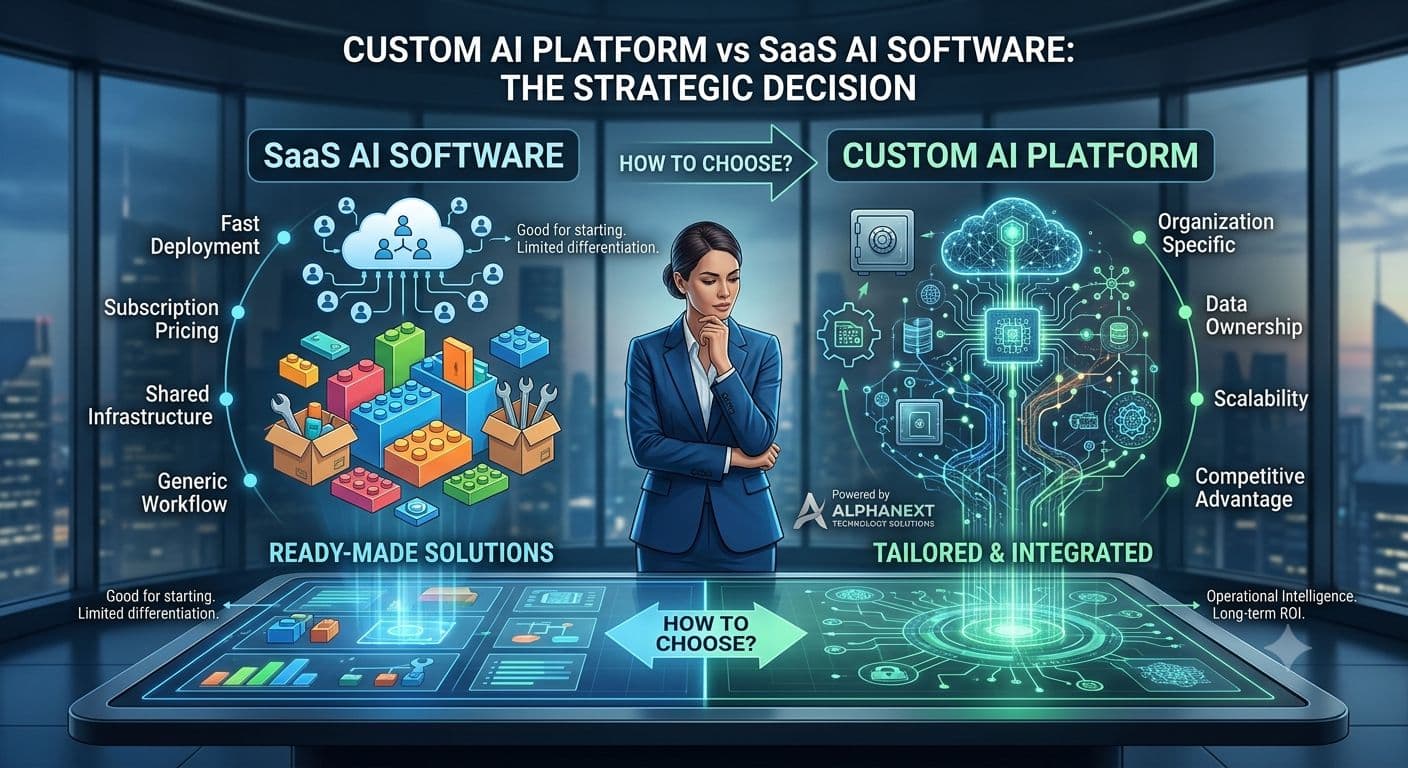
Should you invest in a custom AI platform or use SaaS AI software?
Sounds like a technology decision. It isn't. It's a strategy decision — one that shapes how competitive, scalable, and operationally capable your organization will be over the next several years.
SaaS AI tools offer a fast, low-friction entry point. Most organizations start there, and starting there makes sense. The problem shows up later, when operations grow past what generic platforms were designed to handle — and by then, the switching cost is real.
Choosing between a custom AI platform and SaaS AI software affects scalability, security, workflow depth, competitive differentiation, and long-term ROI in ways that aren't always visible at the moment of purchase but become very visible afterward. This guide breaks down both options honestly, without vendor bias, and gives you a clear framework for making the decision based on where your business actually is.
According to Gartner, 29% of organizations had already deployed and were actively using generative AI by late 2023, making it the most frequently deployed AI technology across enterprises. Gartner also found that 49% of organizations cite proving business value as the biggest barrier to AI adoption, highlighting the importance of choosing the right AI strategy from the beginning.
Key Takeaways
- SaaS AI software offers fast deployment, lower upfront costs, and is ideal for businesses beginning their AI adoption journey.
- Custom AI platforms provide deeper customization, stronger security, and greater scalability for enterprise operations.
- Organizations with unique workflows, sensitive data, or long-term AI strategies often benefit more from custom AI development.
- SaaS AI tools work best for standardized use cases, while custom AI solutions create competitive differentiation through proprietary data and business logic.
- Data governance, integration flexibility, and long-term ROI should be evaluated alongside cost when choosing an AI solution.
- Many businesses start with SaaS AI and transition to custom AI platforms as operational complexity grows.
- The future of enterprise AI is moving toward integrated AI ecosystems powered by custom platforms, AI agents, and organization-specific intelligence.
Not sure whether a custom AI platform or SaaS AI software is the right fit for your business? Speak with to evaluate your use case and build a practical AI adoption roadmap.
What Is SaaS AI Software?
SaaS AI software is cloud-based AI delivered through subscriptions. Writing tools, customer support chatbots, AI-powered CRMs, analytics platforms, productivity assistants, marketing automation — these are built for broad audiences, which is both their advantage and their structural ceiling.
Getting started is fast. No significant development effort. No high upfront cost. The vendor handles infrastructure, updates, and maintenance. For organizations testing AI for the first time, SaaS AI solutions are genuinely the right starting point.
What SaaS AI does well:
- Fast deployment — days to weeks rather than months
- Low upfront investment with predictable subscription pricing
- No internal AI engineering capability required
- Immediate access to AI functionality across common use cases
- Vendor-managed infrastructure and maintenance
The honest caveat: SaaS platforms are optimized for the average customer, not the specific one. The closer your operations are to industry standard, the better they work. The more distinctive your workflows, the sooner you'll hit the ceiling.
What Is a Custom AI Platform?
A custom AI platform is built specifically around an organization's actual workflows, data environment, operational requirements, and business objectives. Not around a generic market assumption — around how this specific business works.
Custom AI development doesn't bolt intelligence onto existing systems. It creates AI solutions that function as the operational layer connecting processes, data, and decisions into a unified environment. The software reflects the business rather than the business adapting to the software.
What a custom AI app typically includes:
- AI workflow automation across specific operational sequences
- AI agents coordinating multi-step processes autonomously
- Predictive analytics trained on organizational data rather than industry averages
- Enterprise knowledge management built around the organization's actual information architecture
- Industry-specific AI applications that handle operational nuances generic tools don't accommodate
- AI-powered decision support calibrated to the specific business context
This is why enterprises that grow past generic AI tools consistently explore end-to-end custom AI platform development and custom AI app development services. Not because SaaS tools stopped working — because the organization outgrew them.
Build custom AI solutions for business and the AI reflects how your organization actually operates. Subscribe to a SaaS platform and your organization adapts to how the platform operates. At low complexity, this difference is manageable. At enterprise scale, it's a structural constraint.
Custom AI Platform vs SaaS AI Software: Key Differences
| Factor | SaaS AI Software | Custom AI Platform |
|---|---|---|
| Deployment Speed | Fast | Moderate |
| Initial Cost | Lower | Higher |
| Customization | Limited | Extensive |
| Integration Flexibility | Restricted | High |
| Scalability | Platform-dependent | Designed for growth |
Why Many Businesses Start with SaaS AI Tools
Starting with SaaS AI isn't a mistake. For most organizations, it's the right first step.
SaaS tools let businesses test AI hypotheses cheaply, build internal confidence before making larger investments, and learn which use cases create real value and which generate more overhead than they eliminate. A marketing team adopts AI content tools. HR uses AI-powered recruiting software. Finance deploys AI forecasting applications available off-the-shelf. Each creates measurable productivity improvements and builds the organizational familiarity that makes subsequent AI decisions better informed.
The learning that happens during SaaS AI adoption — which workflows need integration depth that generic tools can't provide, which use cases require organization-specific data — is genuinely useful input for the custom AI development decisions that follow.
The growing interest in AI adoption is reflected globally. survey found that 88% of organizations now use AI in at least one business function, compared to 78% the previous year. However, only about one-third have successfully begun scaling AI across the enterprise, showing why many organizations eventually move beyond isolated SaaS tools toward integrated AI platforms.
The error isn't starting with SaaS AI. The error is staying there past the point where it's serving the organization's needs.
Planning an enterprise AI roadmap? Explore to assess whether a custom platform or SaaS AI approach aligns better with your business goals.
When SaaS AI Software Starts Creating Limitations
The ceiling appears predictably as organizations grow. Initially, individual AI tools solve isolated problems. Over time, multiple platforms accumulate — none of which communicate effectively with the others.
- Data silos — different AI solutions store information separately, making enterprise-wide intelligence impossible. The analytics platform can't see the CRM data. The AI workflow automation tool doesn't connect to the knowledge system.
- Limited customization — SaaS platforms are built for broad use cases. Industry-specific workflows, unique approval structures, and the operational logic that defines how a particular business runs don't fit the generic templates.
- Integration complexity — connecting multiple SaaS AI systems requires middleware, custom API work, or manual processes that create exactly the coordination overhead AI was supposed to eliminate. More systems means more integration debt.
- Escalating subscription costs — per-user pricing, API consumption charges, and premium tier costs for enterprise features accumulate in ways the initial entry price didn't reveal. At organizational scale, SaaS economics often favor custom AI platform development.
- Restricted competitive differentiation — if your competitors subscribe to the same platforms with the same capabilities, the technology doesn't create sustainable advantage. Custom AI development solutions for business built on proprietary organizational data and unique workflow logic create differentiation that shared subscriptions can't.
This is typically where organizations begin evaluating AI platform development company options, including top AI development companies in India, as strategic partners for building what SaaS tools can't deliver.
Why Enterprises Are Investing in Custom AI Development
isn't about adding AI features. It's about creating operational intelligence that reflects how the business actually works — connecting workflows, data, systems, and decision-making into a unified environment rather than a fragmented collection of tools.
like Alphanext Technology Solutions have become central to this transition, combining engineering depth for production-grade AI systems with enterprise integration experience that makes custom AI development work inside complex operational environments.
Business process automation with AI
The most measurable advantage of custom AI development is automation that goes beyond individual task execution. enable automation of complete operational sequences — approvals, compliance reviews, vendor management, customer onboarding, document processing — where the AI understands business context and adapts to process-specific logic rather than breaking at edge cases.
This is what AI automation services for digital transformation deliver at maturity: not faster execution of individual tasks, but elimination of the coordination overhead between tasks that currently consumes organizational capacity.
AI-powered enterprise application development
AI-powered enterprise application development means building operational systems with intelligence woven into how they function — intelligent dashboards, predictive maintenance platforms, enterprise knowledge management ecosystems, AI-driven logistics planning tools — rather than adding AI features to existing software.
This reflects the fundamental shift in how AI creates business value: not as a capability layer on top of existing systems, but as the operational intelligence that makes the whole environment more capable.
Scalable AI app development for business
As data volumes increase, user adoption expands, and operational complexity grows, the AI system needs to accommodate this growth rather than becoming the bottleneck. Scalable AI app development for business means designing for where the organization is going — three years out, not just today. Organizations planning for significant growth consistently find that the higher upfront investment in development produces better long-term economics than accumulating SaaS subscriptions that need replacing when they hit their operational ceiling.
Why Data Security Matters in the AI Decision
Security is one of the most consistently underweighted differences between SaaS AI software and custom AI platforms.
Most SaaS tools process organizational information in shared cloud environments outside the organization's direct governance control. For routine productivity use cases, this trade-off is acceptable. For organizations handling sensitive client research, financial records, manufacturing specifications, proprietary processes, or healthcare information — shared infrastructure creates compliance exposure that vendor privacy policies don't adequately resolve.
Custom AI development provides a different model. Organizations can deploy AI within their own controlled infrastructure — private cloud environments, enterprise-managed servers, hybrid configurations — keeping sensitive operational data inside governed boundaries.
What enterprise-grade custom AI governance enables:
- Private deployment environments keeping sensitive data within organizational infrastructure
- Role-based access controls enforced at the data layer, not just the interface
- Compliance-focused architecture designed around specific regulatory requirements
- Data residency flexibility for organizations with cross-jurisdictional obligations
- Audit trails in formats that support regulatory review
For regulated industries and GCC operations handling client data with strict confidentiality requirements, this governance capability frequently becomes the deciding factor — making custom AI development not just preferable but operationally necessary.
How Custom AI Supports Digital Transformation with AI
has moved past software modernization. In 2026, it means building organizational intelligence — faster decisions, more reliable customer delivery, and operational scaling without proportional coordination overhead increases.
Getting there requires more than a collection of SaaS AI subscriptions. It requires that connect enterprise applications, automate complex multi-step workflows, generate actionable insights from organizational data, and support cross-functional collaboration at genuine enterprise scale.
Custom AI platforms are better positioned to support enterprise-wide digital transformation with AI solutions for enterprises because they're designed around the specific organizational environment. The integration runs deeper. The AI automation understands operational context rather than following generic rules. The intelligence compounds with organizational data over time rather than staying calibrated to industry averages that may have nothing to do with how this particular business runs.
AI consulting is where this work typically begins — understanding which operational problems have the highest AI leverage, what data infrastructure needs to be in place before AI investment can deliver at the planned level, and how to sequence the transformation so early phases generate the momentum later phases require.
Which Businesses Should Choose SaaS AI Software?
SaaS AI tools are genuinely the right choice in several situations.
- Startups exploring AI before making larger investments benefit from SaaS speed and low upfront cost. The learning is valuable, and the risk is limited.
- Small businesses with operational requirements close enough to industry standard that generic platforms work adequately. If the workflows don't significantly deviate from what the platform was built for, SaaS AI software delivers value without the overhead of custom development.
- Teams testing AI adoption before committing to enterprise-wide initiatives. SaaS tools are a legitimate and cost-effective learning vehicle even for organizations that will eventually move toward custom AI solutions.
- Standardized use cases — content generation, basic customer support automation, standard email assistance — that are genuinely common across many businesses and well-served by existing platforms.
The strategic error would be treating these situations as permanent. SaaS AI as a starting point is sensible. SaaS AI as a ceiling is expensive.
Which Businesses Should Choose Custom AI Development?
Custom AI development — whether through an enterprise AI software development company partnership or through one of the — becomes the stronger choice in specific situations.
- Unique operational workflows that define competitive advantage. When how an organization executes its core processes differs from industry norms in value-creating ways, generic platforms consistently fail to reflect those differences. Building custom AI solutions for business preserves what makes the organization distinctive rather than averaging it out.
- Enterprise-scale automation requires cross-system coordination. Large workflows spanning multiple departments, multiple systems, and multiple decision points need AI that understands the full operational context — something that disconnected SaaS tools can't provide regardless of individual tool quality.
- High data security requirements from regulated industries, GCC environments, or organizations with sensitive client data. Custom AI platform development keeps data within governed boundaries that shared infrastructure can't match.
- Competitive differentiation that depends on AI. When AI is a source of competitive advantage rather than operational hygiene, the capability needs to reflect organizational data and operational intelligence — not be equally available to competitors who subscribe to the same platform.
- Long-term scalability planning. Organizations expecting significant growth in operational complexity, user scale, and integration requirements are better served by scalable AI app development for business that's designed for where the organization is going.
For these businesses, a custom AI platform becomes strategic infrastructure — creating compounding competitive advantage rather than operating as a tool that needs replacement when it hits its limits.
The Future of AI Is Moving Toward Customization
The enterprise AI market is structurally shifting from tool adoption toward ecosystem building — from subscribing to AI products that address specific visible problems toward creating integrated AI infrastructure where data, workflows, automation, and intelligence function together.
This shift is driving demand for custom AI app development services, custom machine learning and AI development services relationships globally — and particularly from , where engineering depth, enterprise integration experience, and development economics combine at a level few other markets can match.
Businesses are increasingly investing in AI agents that coordinate complex workflows autonomously, predictive analytics that surface developing problems before they materialize, enterprise knowledge systems that make organizational intelligence continuously accessible, and decision intelligence platforms that improve decision quality at scale. These capabilities require deeper integration than SaaS products provide. They require AI systems built on organizational data, designed around specific operational environments, and calibrated to improve as more organizational data flows through them.
The organizations building this through custom AI development now are creating the operational foundation that makes the next generation of AI capabilities significantly more accessible when they arrive — and widening the gap from competitors still managing through accumulated SaaS subscriptions.
How AlphaNext Supports Custom AI Development and Enterprise AI Transformation
Moving from AI experimentation to production AI that drives operational outcomes requires a partner who understands both the technology and the operational environment it needs to work inside.
works as an enterprise AI software development company that combines AI consulting with practical custom AI development — building AI systems designed around how organizations actually operate rather than delivering demonstrations that don't survive contact with real-world complexity.
Services that support enterprise AI transformation:
- Custom AI development and custom AI platform development built around specific operational workflows
- AI software development for enterprise applications across recruitment, manufacturing, knowledge management, and communication intelligence
- AI automation services for digital transformation that connect workflows rather than automating them in isolation
- Custom machine learning and AI development services training models on organizational data
- AI consulting that defines the operational problem before selecting the technical approach
- Generative AI development for enterprise knowledge workflows and communication automation
- AI product development for businesses building AI-powered products
- Business process automation with AI addressing coordination overhead between process steps
- Digital transformation with AI solutions for enterprises creating genuine operational capability
is among the recognized AI development companies in India for organizations seeking AI that reflects operational reality rather than requiring operations to adapt around it.
Still deciding between SaaS AI software and custom AI development? Let AlphaNext assess your business requirements and recommend the most cost-effective AI strategy based on your operational goals.
Conclusion: Which AI Approach Is Right for Your Business?
The decision between a custom AI platform and SaaS AI software comes down to where the organization is in its AI journey and where it's planning to go.
If speed, simplicity, and lower upfront investment are the immediate priorities — SaaS AI tools deliver value quickly. For organizations early in AI adoption, with standardized use cases and limited internal technical resources, subscription AI solutions are the appropriate starting point.
If scalability, customization, data security, workflow automation, and long-term competitive advantage are the priorities — custom AI development is the stronger investment. For organizations where AI is becoming operational infrastructure rather than a productivity feature, custom AI solutions for business create compounding value that generic platforms structurally can't match.
The organizations gaining sustainable advantage from AI aren't choosing based on what's trending. They're choosing based on what their operational situation actually requires — and building toward AI capability that reflects their unique workflows, organizational data, and competitive positioning rather than a generic template any competitor can access equally.
Whether that means starting with SaaS AI today and evolving toward custom AI platform development as requirements mature, or moving directly to end-to-end custom AI platform development based on current scale — the decision should follow the business strategy. The AI serves the strategy. Not the other way around.
Frequently Asked Questions
What is the difference between a custom AI platform and SaaS AI software?
SaaS AI software provides pre-built AI capabilities through a subscription model, while a custom AI platform is developed specifically around an organization's workflows, data, and business requirements. SaaS offers faster deployment, whereas custom AI provides greater flexibility, control, and long-term scalability.
Is custom AI development more expensive than SaaS AI?
Initially, yes. Custom AI development typically requires a larger upfront investment. However, for organizations with complex operations, multiple AI tools, or high user volumes, custom AI platforms often deliver a higher long-term return on investment by reducing subscription costs and improving operational efficiency.
When should a business move from SaaS AI to a custom AI platform?
Businesses should consider custom AI development when they encounter limitations with SaaS tools, such as restricted customization, integration challenges, data security concerns, or the need for AI capabilities tailored to unique workflows.
Are custom AI platforms more secure than SaaS AI tools?
Custom AI platforms generally offer greater control over data governance, deployment environments, compliance requirements, and access management. This makes them particularly valuable for regulated industries and organizations handling sensitive business or customer data.
Can custom AI platforms integrate with existing ERP and CRM systems?
Yes. One of the major advantages of custom AI platform development is the ability to integrate deeply with enterprise systems such as ERP, CRM, HRMS, manufacturing platforms, and internal databases.
Which industries benefit most from custom AI development?
Industries with complex workflows and large volumes of operational data—including manufacturing, healthcare, financial services, logistics, GCCs, and professional services—often achieve the greatest value from custom AI solutions.
How long does custom AI platform development take?
The timeline depends on complexity and scope. A focused AI solution may take 6–12 weeks, while enterprise-wide AI platforms involving multiple integrations and advanced automation capabilities may require several months of phased implementation.
What should businesses evaluate before choosing an AI solution?
Organizations should assess operational requirements, data readiness, security needs, integration requirements, scalability goals, expected ROI, and whether their workflows require customization beyond what SaaS AI software can provide.
Explore how helps businesses build custom AI platforms, AI automation systems, and enterprise AI software at alphanext.tech